School order under the Prince's rule
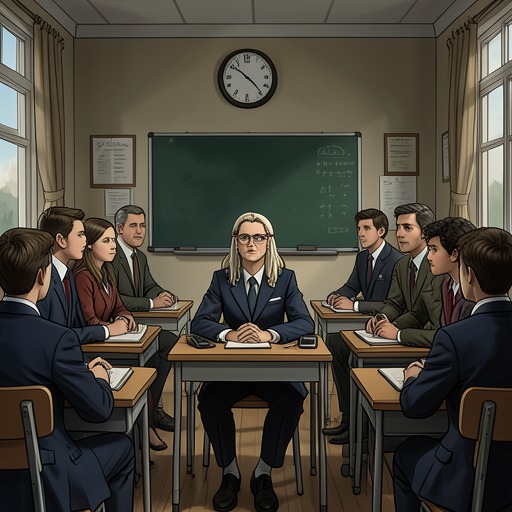
Bullet TrainSchool order under the Prince’s rule is a regime of fear that makes students feel powerless, damages their trust in one another, and encourages them to police their own behavior. Its force lies not only in the Prince’s punishments but in the expectation that resistance will fail: classmates carry out his instructions even when they recognize the harm, and the possibility of acting together against him scarcely occurs to them. Kimura’s account links that paralysis to repeated punishment, engineered shame, and the deliberate breaking of personal loyalties.
Obedience and the apparent impossibility of resistance
The students’ explanations expose how the Prince’s authority reaches beyond a single order. A round-faced student says that he and the others did only what the Prince told them to do, and connects their treatment of a girl to the fact that Takuya’s father was trying to find out about the Prince. Another student darkly reports that the Prince has also got rid of three teachers. Together, these remarks present a school in which obedience is reinforced by consequences that reach classmates and adults alike. The students’ compliance is not described as agreement with the Prince; it is behavior shaped by the perceived danger of disobeying him.
Kimura suggests that the students could overcome the Prince if they acted together. He points out that the Prince does not seem especially strong and that numbers could matter even if he were skilled in martial arts. Yet the students have never seriously considered joining forces to topple him. The absence of that thought is as revealing as any explicit order: the Prince’s control has narrowed what they imagine to be possible before they even attempt resistance. The crucial obstacle is not simply the Prince’s individual strength but the students’ expectation that they cannot prevail.
Learned helplessness and fear’s effects
Kimura interprets the students’ paralysis through the example of a dog subjected to electric shocks. In the experiment he describes, the dog could later avoid a shock by jumping, but after first experiencing a situation in which it was shocked regardless of what it did, it stopped trying to escape. Kimura explains the pattern as learned helplessness: repeated experiences of having no control can make a person cease trying even when action might help. He extends the comparison to people living with domestic violence, describing how helplessness can take root and persist.
He sees a similar process among the students. Their classmates and adults have suffered at the Prince’s hands repeatedly, and Kimura considers that accumulated experience enough to convince them they are powerless. Electric shocks may be part of that conditioning, although he does not know exactly how they are administered or what orders the Prince gives. His interpretation therefore distinguishes the punishment itself from its broader psychological consequence: the students have learned to expect that no response will protect them.
The book gives the threat a concrete instrument in a prototype medical device capable of administering electric shocks. A classmate whose father is a doctor and runs a private clinic first mentions the device. It resembles an automated external defibrillator used to restart a stopped heart, but is stronger than an ordinary one; later, students are told to put on its pads. The device’s medical origin does not make its role benign. In this school, technical knowledge and equipment become part of the means by which fear is imposed, while the students’ handling of the pads makes their participation in the system visible.
Distrust as a method of control
Kimura recognizes that fear also rearranges the students’ relationships. In his assessment, a group ruled through fear loses trust from within: anger at the despot is redirected toward people who should be allies, and everyone concentrates on avoiding personal punishment. Students begin watching one another, making collective resistance still less likely. This is not merely a collection of frightened individuals. It is a social order in which each person’s attempt to stay safe helps preserve the isolation that keeps the Prince secure.
Kimura compares that pattern with what he heard about Terahara’s organization during his former work carrying a gun. Members of that organization were suspicious of one another and tried to avoid mistakes so that Terahara’s anger would fall on somebody else. Their mutual suspicion eventually turned them against one another as they looked for someone to offer up in their place. The comparison clarifies the mechanism at work in the school: concentrated authority can be protected by making those below it compete to avoid blame. The students’ fear does not simply silence them; it weakens the trust that might let them act together.
Shame, betrayal, and the Prince’s strategy
The Prince’s rule also attacks the students’ sense of self-worth. He exploits private sexual desires by uncovering and exposing them, or confronts students with their parents’ sexual behavior in order to damage the image of adults on whom they depend. The significance in the account is not that these desires are unusual; it is that exposure makes students ashamed and undermines their confidence in themselves. The Prince is surprised by how effective this tactic proves to be. Humiliation becomes a means of rule because it makes a person’s private life feel like another point of vulnerability.
The next step is to make a student betray someone important to them, whether a parent, sibling, or friend. Such betrayal further diminishes the student’s self-worth by damaging a valued bond as well as the student’s self-image. The Prince intends this kind of test for Tomoyasu and his Dog. In that plan, the school’s system of control extends from fear of punishment to the corruption of loyalty: students are pressured not only to obey but to participate in harm to someone they care about.
The order under the Prince is therefore sustained by mutually reinforcing pressures. The shocks and threats teach students to anticipate pain; shame makes them feel personally diminished; betrayal damages the ties that could support resistance; and distrust turns classmates into watchers and potential scapegoats. Kimura’s analysis identifies why an apparently stronger group can remain submissive to one ruler: repeated helplessness has made collective action difficult to imagine, while the Prince’s methods continually reproduce the isolation that prevents it.